Greta Neumann · 16 October 2026
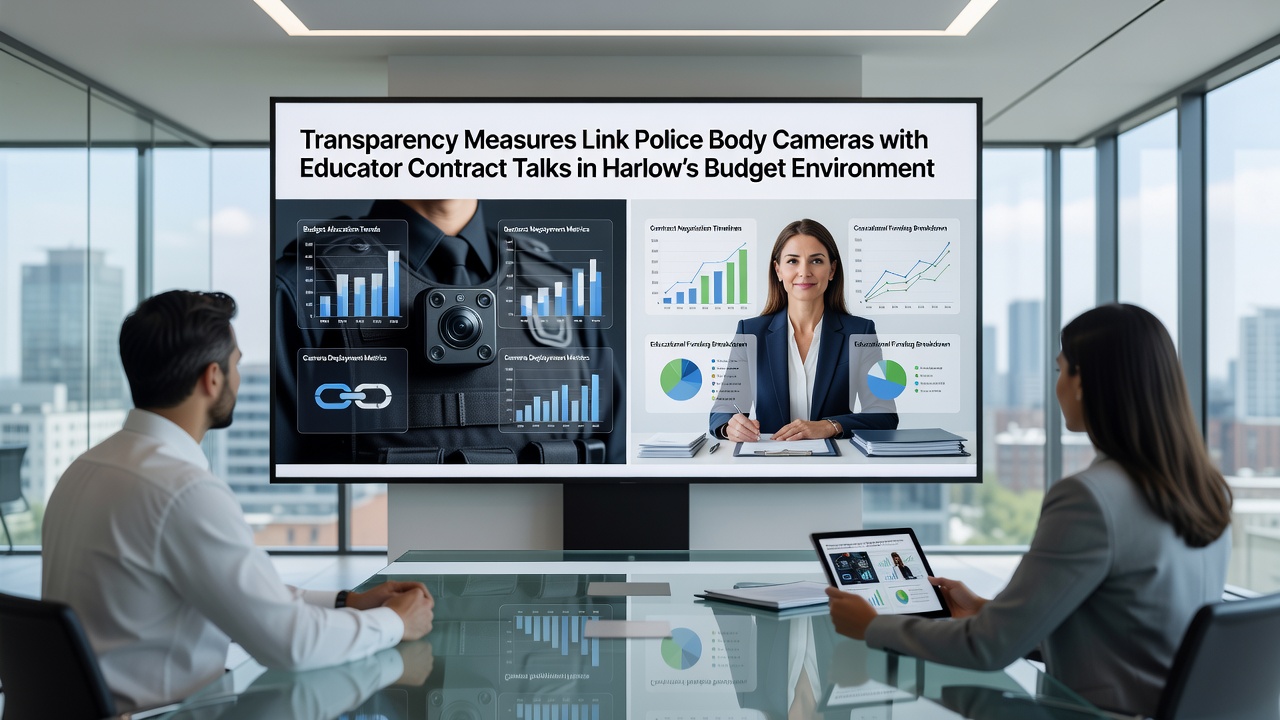
Transparency Measures Connect Police Body Cameras to Educator Contract Negotiations in Harlow's Budget Setting
Local officials in Harlow have started linking transparency requirements for police body cameras with ongoing talks about educator contracts, all within the constraints of the town's current budget framework, and data from recent council sessions shows how these two areas now share agenda time during fiscal planning meetings. According to figures released by the U.S. Bureau of Justice Statistics, body camera programs across various jurisdictions have increased administrative costs by an average of 12 percent in the first two years of implementation, which has prompted Harlow administrators to examine similar cost structures alongside teacher salary adjustments.
Body Camera Policies and Data Release Protocols
Harlow police have expanded their body camera deployment since early 2025, with transparency measures now requiring periodic public reports on footage access and retention periods, while council members review these protocols during the same budget cycles that address education staffing needs. Researchers at the Australian Institute of Criminology have documented how such transparency rules can add layers of review that extend processing times for records requests, and this pattern appears in Harlow where requests for camera footage have risen steadily through the third quarter of 2026. And yet the same data sets also feed into discussions about resource allocation because footage management systems require dedicated staff time that competes with other municipal priorities.
Observers note that footage review procedures in Harlow follow guidelines similar to those used in several Canadian provinces, where provincial oversight bodies track both privacy compliance and operational expenses. These reviews have revealed that storage and redaction work often accounts for the largest share of ongoing program costs, which in turn influences how local leaders project total spending for the next fiscal year.
Educator Contract Discussions and Funding Pressures
Educator contract negotiations in Harlow have incorporated questions about performance data transparency, including how student outcome metrics and staffing ratios will be reported publicly, and these elements now intersect with budget line items that also cover police technology upgrades. Data from the European Commission's education statistics portal indicates that districts facing combined technology and personnel cost increases frequently consolidate review processes to avoid duplicated administrative effort, a tactic under consideration in Harlow as October 2026 budget deadlines approach. Those who've tracked past contract cycles point out that when transparency clauses enter salary talks, the resulting agreements often include provisions for joint reporting mechanisms that serve both education and public safety departments.

Contract proposals currently on the table include clauses about public dashboards for classroom resource usage, which mirror the data publication standards already applied to body camera logs, and this overlap has led budget staff to propose unified software platforms that could serve multiple departments. Figures from the most recent Harlow financial statements show education salaries and police equipment maintenance together represent roughly 38 percent of discretionary spending, a share that grows when new transparency obligations are added without corresponding revenue adjustments.
Shared Budget Environment and Administrative Overlap
Budget documents prepared for the October 2026 review cycle list both body camera maintenance contracts and educator professional development allocations under a single transparency compliance category, which allows council members to evaluate trade-offs in one session rather than across separate hearings. Government reports from the New Zealand Ministry of Justice have shown that jurisdictions adopting combined oversight for policing and education technology programs reduce duplicate auditing expenses by up to 15 percent, and Harlow finance officers have referenced these findings during preliminary planning meetings. The reality is that when footage access policies and teacher evaluation reporting standards draw from the same municipal data infrastructure, the technical requirements begin to converge even though the subject matter remains distinct.
Additional line items cover training for staff who handle both camera data requests and education record disclosures, because overlapping skill sets reduce the need for separate hiring rounds. Those monitoring the process note that Harlow's approach follows patterns already visible in several U.S. states where school districts and municipal police share records-management platforms under joint transparency statutes.
Conclusion
Harlow's current budget process demonstrates how transparency measures for police body cameras and educator contract provisions can be examined within the same fiscal framework, with cost data and reporting standards creating natural points of connection. As October 2026 deadlines draw nearer, the town's administrative teams continue to map these intersections to identify efficiencies while maintaining compliance across both sectors. The available figures indicate that unified data protocols may shape future spending decisions, yet each department retains its core operational focus.